
Guillaume Verdier: "AI is not the one designing our boats!"
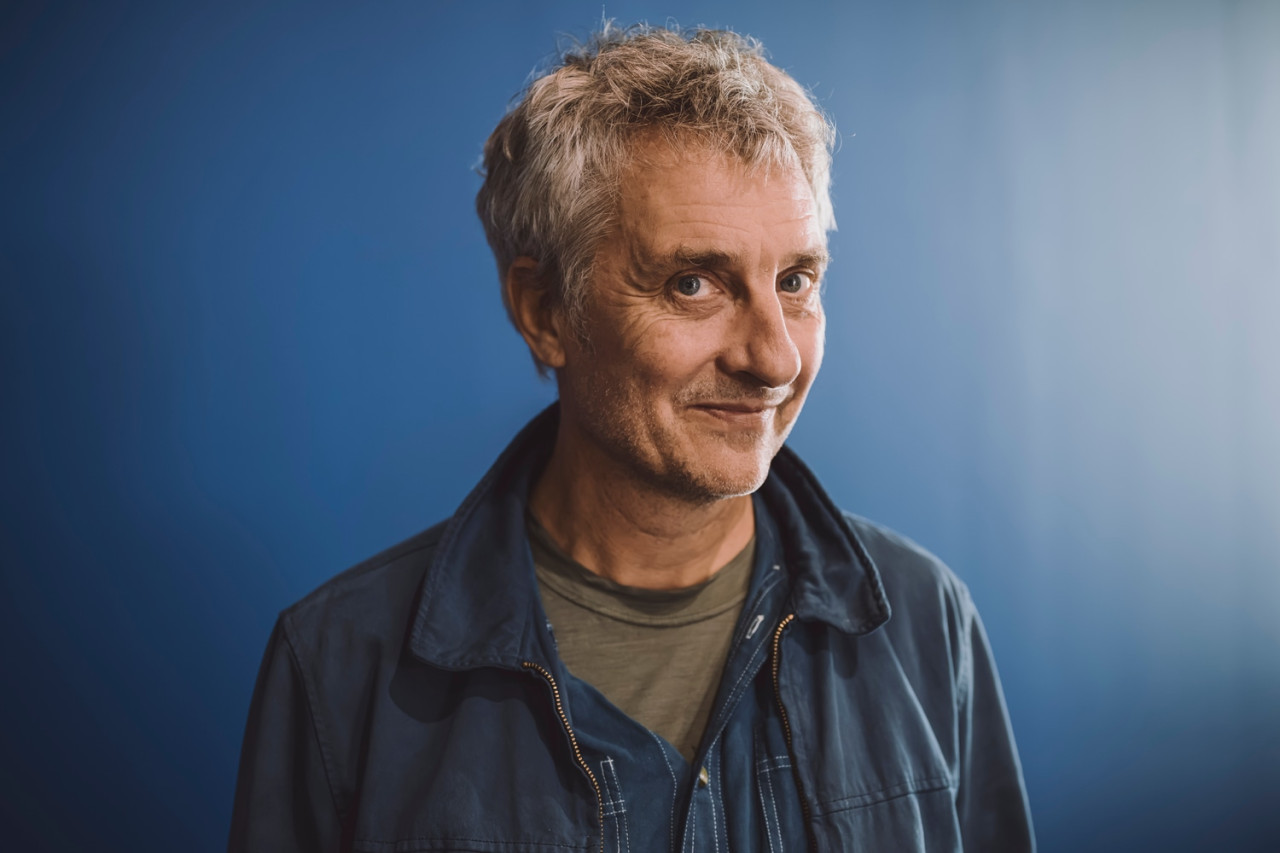
Guillaume Verdier participated today in the innovation conferences organized by the Défi Azimut Lorient Agglomération. Alongside Loïc Goepfert, a member of his "gang" as he likes to call them, he took stock of his work in the IMOCA class.
How did the bustle from the AC 75s (America's Cup) find its way into the IMOCA class on boats like DMG Mori Global One (Kojiro Shiraishi) or Groupe Dubreuil Air Caraïbes (Sébastien Simon)?
Guillaume Verdier: "It comes down to the trust our clients placed in us. Kojiro really liked the fact that we went in a different direction, with the idea of making a boat that is more pleasant and at the same time faster downwind. And he assured us that if it didn't work right away, they would help us get there! Before that, we have them try it out on a simulator so they can clearly visualize what it can produce in real life. Sébastien Simon was convinced. And that's not to mention Charlie Dalin, who worked with us for six months. He helped us a lot. He was convinced we would succeed. He trusted us."
Loïc Goepfert: "Charlie was incredibly enthusiastic. He tried the simulator, he looked at the numbers. The last time we spent time with him, we designed foils together. He passed on a lot of knowledge to us during those few months. We knew Charlie well as a skipper, but during those six months, we worked with Charlie Dalin the naval architect... Sam Goodchild was already in place as a sailor, so Charlie was there to design with us. He gave us so much by sharing his crazy amount of experience!"
Guillaume Verdier: "In the end, we'll see how it pans out in terms of performance on the Vendée Globe; but we have the guarantee that it will be less physically demanding. In the simulations, it slams much less, and when I had the opportunity to try it, I could really feel that it was smoother."
Have your digital tools evolved a lot in recent years to achieve these results?
Guillaume Verdier: "For IMOCAs, most of the time we use Gombock, developed by Team New Zealand, with whom I have worked a lot, and which many architects use because they commercialized it. For fluid dynamics calculations, we now rely on digital solutions rather than tank testing, which is expensive. Digitally, we use a software that isn't just used for offshore racing—Fine Marine... But what matters is thinking properly. A lot of basic calculations are still done by hand, and the same goes for logic. AI is not the one designing our boats! We are at the very beginning of these technologies, and personally, I am not a geek."
Beyond hull shapes, where does the potential for development lie?
Guillaume Verdier: "I would love for mast designs to be open, rather than one-design. When it comes to sail plans, we are still in the Stone Age. There is a huge amount of potential and plenty of innovations to imagine, like jib booms for example, if only to make it easier to handle solo."
Loïc Goepfert: "Regarding rudders, there is also a lot of potential. At Charal, they made a step forward in this area, but we think the rudders are too long. I hope we will move toward small T-rudders. Perhaps they will allow older boats to be equipped with them, which could help level the performance potential."
Guillaume Verdier: "It's really great that Charal decided to cut the boat's hull and modify its lines. I am all for diversity... I am always a bit anxious when I look at my competitors' boats; some of them are very beautiful. I decided to stop banking on heel angle. They are still building boats with that in mind. These different hulls all have their preferred points of sail. Macif Santé Prévoyance, which aims for versatility, is still working very well. There is room for many solutions. And it is very interesting to see that Antoine Koch favors narrower shapes. And since his boats are sailed by good skippers, it leaves the door open to a lot of potential. In the end, it's still the sailors' talent that levels out much of the performance."
In your opinion, what are the ways to make performance on the water and environmental performance coexist?
Guillaume Verdier: "Why not imagine transforming IMOCAs into cruising boats so they don't go to waste?! In any case, it's an avenue to explore, as Christophe Baley, a researcher at the Université Bretagne Sud, points out: focusing right from the design stage on the destruction or new uses for these boats."
Loïc Goepfert: "We should start by stopping our hyper-focus on construction. The very well-documented report by 11th Hour Racing on the life cycle assessment of IMOCAs is crystal clear. It is written in black and white: construction only represents 10% of the impact. The other 90% is due to transport, sailing around the world for The Ocean Race, partners traveling, etc. Regarding construction, very concrete steps have already been taken, notably with the introduction of the Eco-Score (a tool used to regulate and reduce emissions linked to the construction of new boats). There is a lot of room for maneuver around the concept of circular races like the Vendée Globe."