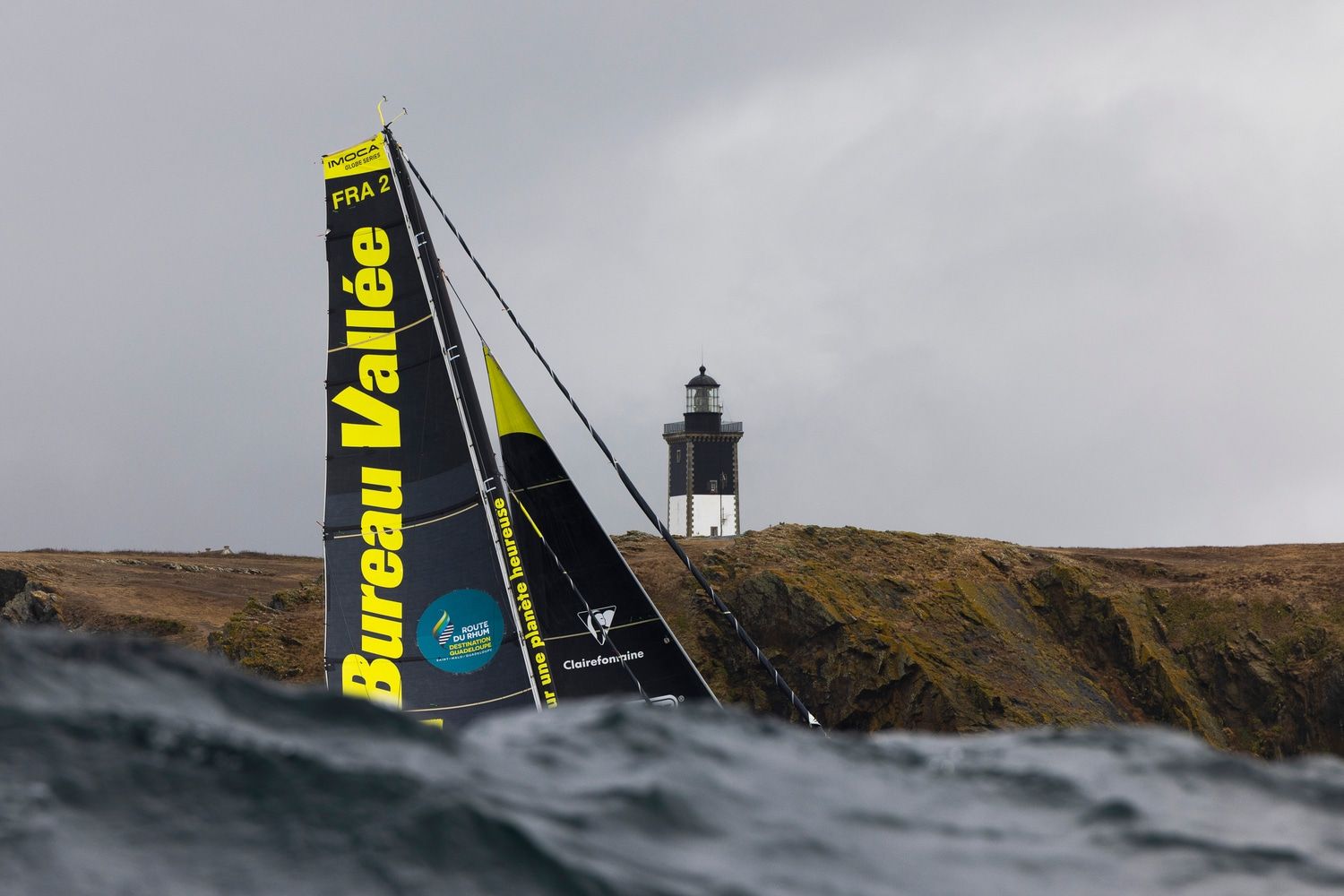
48 H Azimut: front rolling in!
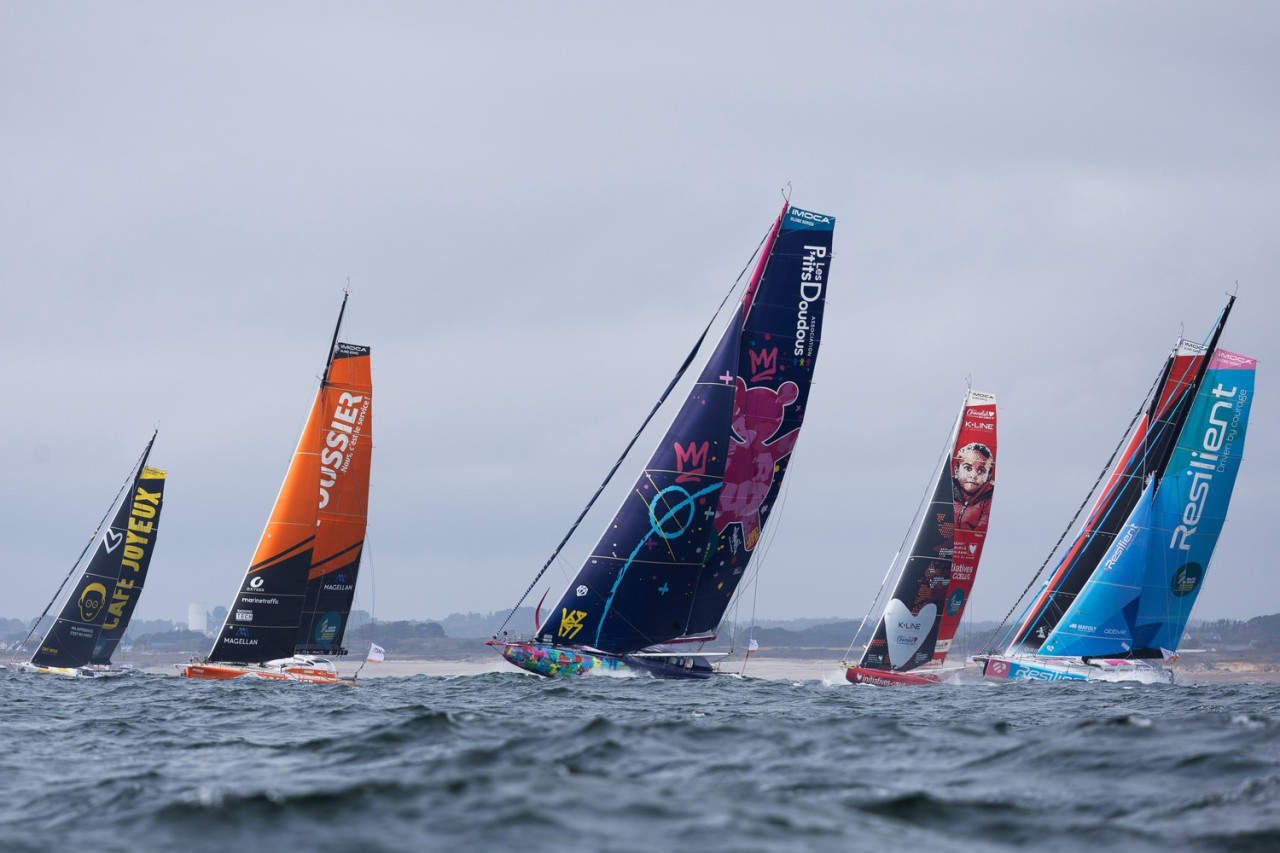
14 boats set sail in 18-20 knots of breeze along the 560-mile course labelled the 48 H Azimut, which will likely be action-packed given the varied conditions.
There has been a change of scene in the waters of the Coureaux de Groix between Lorient and the island of Groix. Yesterday’s sunshine and flat seas have given way to cloudy skies this Thursday, with the race zone stirred up by a sizeable chop. The culprit is a small front, which is about to make landfall at the north-west tip of Brittany and is setting the tempo for what is forecast to be a high-paced start to the race.
The importance of getting off to a good start
With the race setting sail at exactly 3:30 pm local time and an initial beat to Pen Men, to the north of the island of Groix, the fleet soon eased their sheets and opened their sails. The drag race has begun for the foilers, who set off under full mainsail and J2. Straightaway, the most seasoned sailors, who were the fastest to take off in yesterday’s runs, moved up to the head of the fleet, but they will have to remain on the look-out for any acceleration in the wind as their rivals are on their sterns, poised to attack. The entire fleet is making for the first BXA mark, the famous buoy marking the entrance to the Gironde estuary, which the first boats are expected to reach before midnight.
The focus right now for the solo sailors is to stick with the front runners and avoid being overtaken by the low-pressure system for as long as possible in this 150-mile sprint from Groix to BXA. “Getting off to a good start and not hanging around is vital as things are set to get tricky later on,” confirms Race Director, Francis Le Goff, in reference to the second half of the course, which is forecast to be a lot less breezy. In his view, this first leg won’t be easy as the skippers try to post good speeds whilst getting reacquainted with solo format and a new boat in certain cases.
Such is the case for Sébastien Simon (Groupe Dubreuil-Air Caraïbes), who is heading offshore for the first time in this Défi Azimut aboard his cutting-edge Verdier design, whose hull lines are directly inspired by the America’s Cup. The same is true for Corentin Horeau (MACSF), who has taken over the helm of Yoann Richomme’s powerful boat. A Défi Azimut rookie, he’s also competing in his very first season on the IMOCA circuit. Meantime, Violette Dorange (Initiatives Cœur), who has already scored two podium finishes in the pre-season events, is proving that she has a real feel for her red rocket and still loves an adventure!
A match within a match for the daggerboard boats
After an hour and a half of racing, there is very little separating the boats and the head of the fleet is racking up speeds well in excess of 25 knots. The four daggerboard boats have all been enjoying a great start, Café Joyeux (Nicolas D’Estais) and Foussier (Sébastien Marsset) leading the attack in what promises to be an incredibly intense match within a match.
A ridge of high pressure to round off the action…
In contrast to the more powerful foilers, the IMOCAs with daggerboards set sail with one reef in the mainsail to transition through the heavy seas more smoothly. As a result, they’re likely to stall quite a lot before the BXA mark as the wind veers and forces them to start juggling downwind sails. For the second half of the race, a ridge of high pressure climbing up from the south is set to scoop them up tomorrow. This new weather system will bring with it lighter airs, which could slow progress considerably on the climb up to the second course mark, Azimut 1, located 100 miles to the west of Penmarc'h. In light of this threatening forecast, an amendment to the Sailing Instructions explains that the finishing line in this 48 H Azimut 2026 will close at 10:00 am on Sunday morning, rather than the original 10:00 pm on Saturday. With the racecourse open for an extra night to determine a worthy winner, there is everything to play for in act 2 of the Défi Azimut-Lorient Agglomération…
Quotes from the boats
Jérémie Beyou (Charal) “We had a great day during yesterday’s speed runs and we were happy to rediscover a fully functioning boat and entire hydrodynamic package of rudders and foils very early on. With the change of hull, we kept the foils in the same place, but we modified their profile and it looks like that’s working well. When conditions pick up, Macif is very powerful and there’s not a lot left in the water to create drag, so she’s kind of the boat to beat in these conditions. For the 48 H race, breezy upwind conditions are lacking a bit in our preparation for the Route du Rhum, but we’ll do the best we can with what we’ve got. The first leg should be good if we can stay ahead of the front. After that, the ridge of high pressure might well be difficult to negotiate so it’ll be quite a technical challenge to remain quick. It’s my first single-handed race since the Vendée Globe, so I’ve still got to find my bearings in contrast to those skippers who have competed in some of the pre-season events and will likely be more into their stride than me. I’m going to try and stay with them and find my feet.”
Sébastien Marsset (Foussier) “The wind is favourable for setting sail and then a front will roll over us during the night, so we’ll see where we’re at on the first leg when things begin to stall. After that, the climb up to the Azimut waypoint will be flukey. We’ll have to be on deck, carefully monitoring each wind shift, but the big question for us daggerboard boats is what time we make the finish. This Défi Azimut is all about the sport but it’s also an event aimed at paying tribute to our partners. Right now, the ETAs won’t enable us to honour the commitments we have on Sunday. The best routing puts us in Lorient just after the line closes. The worst shows us finishing on Sunday afternoon! As such, we may have to make some tough choices ourselves if Race Management don’t make them. It would have been better to think about that ahead of time in my view. We can’t control the weather but it’s clear to see that the difference in performance between the foilers and daggerboard boats is more and more significant. Over a very short course like the Azimut, where boats are being sailed hard, it’s a tough balance to strike.”
Pierre-Louis Attwell (Résilient) “I’m really happy to be here. We had a wonderful day yesterday during the Runs and it was great to be with the other IMOCAs, because I’ve only competed on my own so far in the Drheam Cup. I’m quietly confident because we’re on the attack with a medium wind and it’s going to be interesting to size up the other daggerboard boats. We’re not going to finish before the deadline though so we’re wondering how that will play out. Setting sail when you’re bound to get a DNF is not very pleasant so we’ll have to see if there will be a plan B for us. You never know, the weather may change too, but for now none of the GRIB files show us getting to the finish in time. Ultimately, if the Défi Azimut is only aimed at foilers, we’ll have to do something else.”
Élodie Bonafous (Association Petit Prince-Groupe Quéguiner) “This Défi Azimut is well paced. This is the first time I’ve really been sailing since the summer refit, so my goal is to validate everything on the boat. The course and the line-up are reminiscent of all the elements that we’ll have to face in the upcoming Route du Rhum. It’s a thoroughly comprehensive course with a bit of breeze and then precious little, along with a fair amount of strategy, so it’ll be interesting. I’ve never sailed single-handed with an OBR aboard. I’ll be accompanied by Romain Marie this time so that’ll be nice as we get on well. He’s pressuring me to get the boat airborne on the first leg! There’s bound to be some gaps opening up by the BXA buoy, but not as much as on yesterday’s Runs, which was rather special to say the least! It all depends on how intensely we all sail this first leg. Once night falls, if there are any sail changes to make, that’s where any differences will really show up and I hope I won’t be too far behind at BXA.”
Corentin Horeau (MACSF) “I think we’ll need to sail as fast as we can so as not to get swallowed up by the front, as the wind will shift on the back of that and then go light. If all goes to plan, I know I have a boat that’s quick, so it’s up to me to get a good start and push the limits. There will be quite a lot of separation at the bottom, but the first boats will stumble against the light airs on the second leg. We will likely squeeze up again at the end, so it’ll be just like a Figaro leg!”